2026 11 10 - John, now Brother Thomas, and I have been friends for many years. He called me yesterday about an amazing observation that no one else has ever made regarding Veronica’s Veil.
Note: According to historical data:
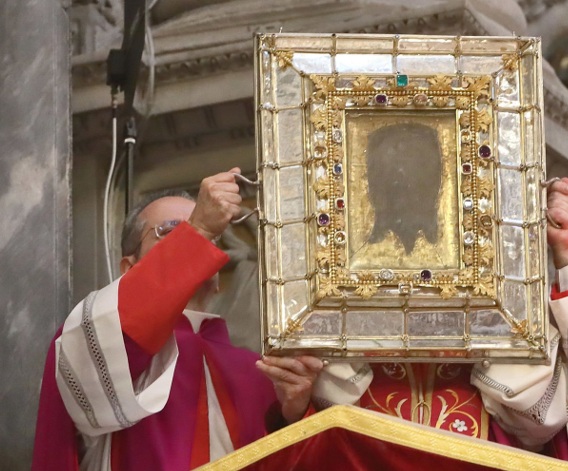 The original Veil of Veronica: It is kept in St. Peter’s Basilica at the Vatican is one of the most heavily guarded and rarely seen relics in Christendom. Because it is preserved inside a specialized frame built deep within one of the colossal structural pillars supporting the main dome, it is heavily obscured by time and only exhibited to the public briefly once a year from an elevated balcony.
- The 1849 Miracle Reproductions: Following a documented event in 1849 where the original veil allegedly glowed vibrantly for three hours, Pope Pius IX commissioned artists to draw precise copies. These engraved copies were touched directly to the original relic, stamped with the Vatican seal, and distributed globally.
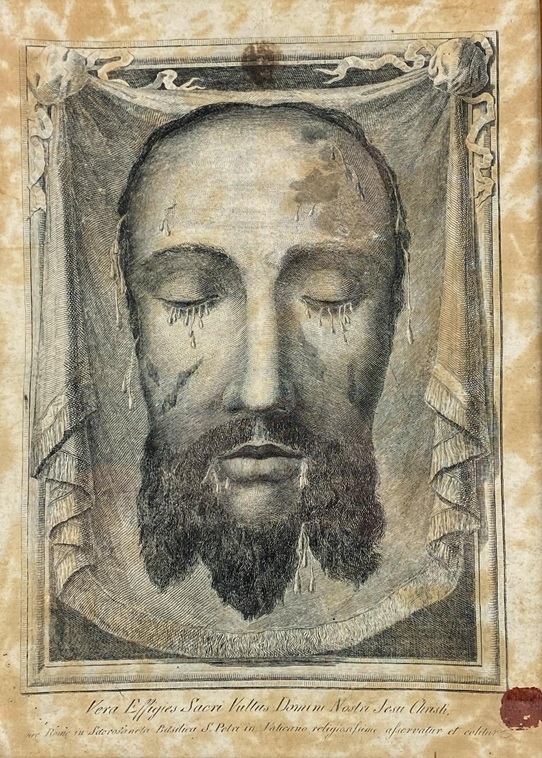
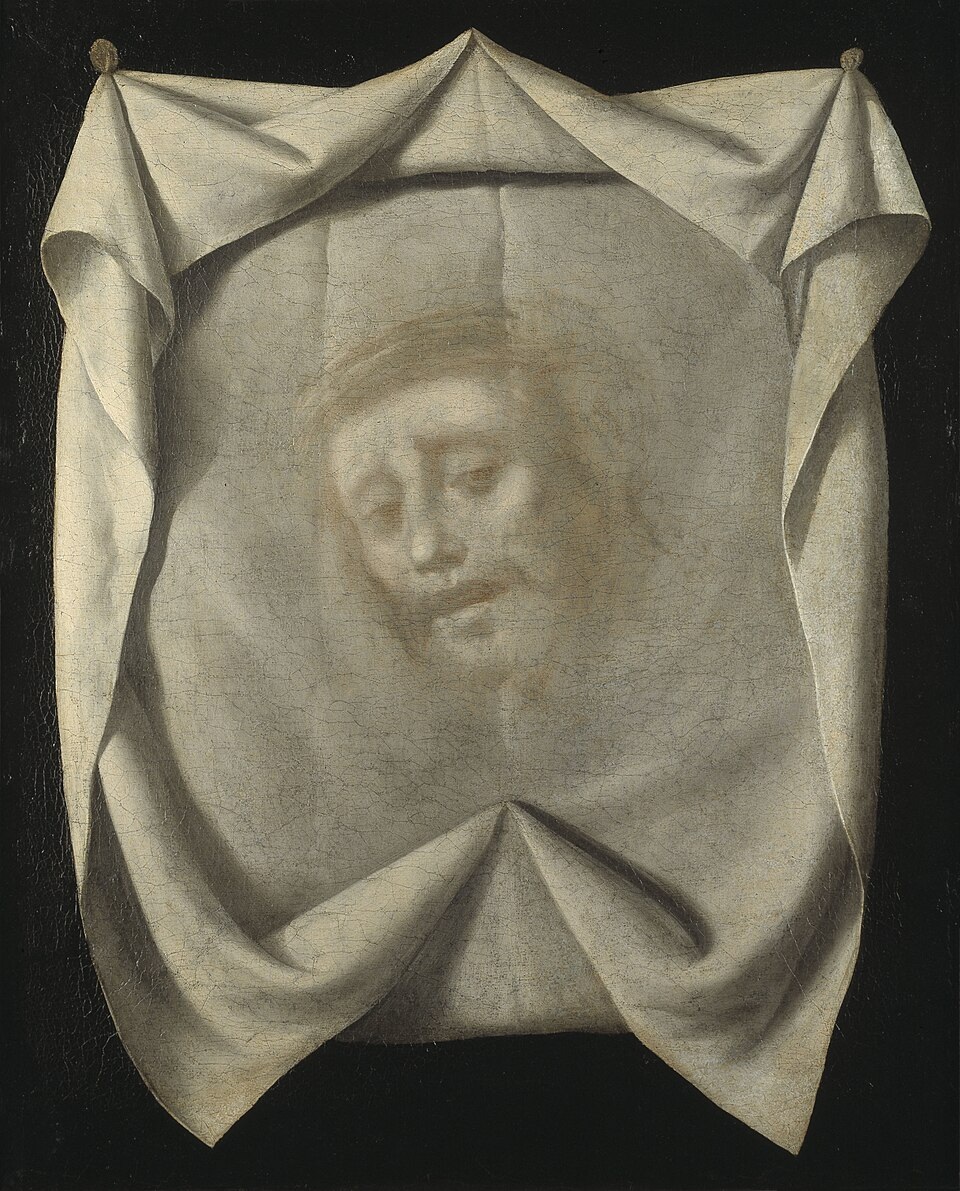
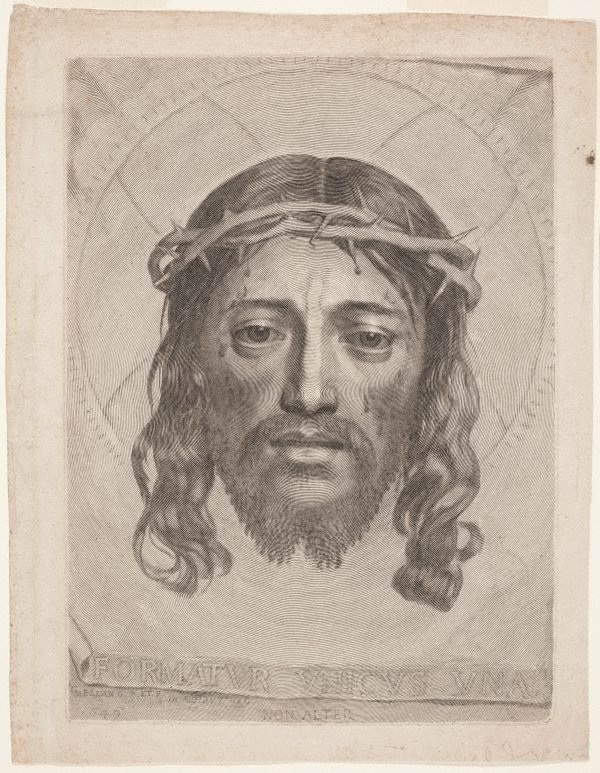
John found two faces on the cloth! One is facing forward, and the other is turned toward the viewer’s left. John noted to me how different artists have historically drawn the face of Jesus based on the specific face they perceived on the veil. Because of the ancient bloodstains and the degradation of the cloth over time, it is difficult today to clearly make out Jesus's features. Nevertheless, it is possible to locate where the eyes are and start from there.
Interestingly enough, some artists portrayed Jesus facing forward, while others depicted Him looking to the left. So, who was right? Since there are actually two distinct faces imprinted on the Veil, both interpretations were correct. Even more fascinating, some artists combined elements from both faces into their artwork.
John theorizes that Veronica initially approached Jesus on His way to Calvary from the side and wiped His face for the first time, covering more of the right side than the left. Then, Jesus turned directly toward Veronica, and she performed a second wiping of His sweaty and bloody face—this time, His face pressed completely forward into the fabric. These sequential actions left two overlapping imprints of His face on the single cloth.
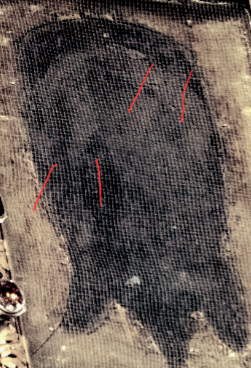 He texted me a picture of the Veil alongside a copy of the same image with his added markings pointing toward the locations of the four eyes. However, my old iPhone could not cleanly render his original images; all I could see was a blurry brown stain with red lines.
I decided to put it to the test. If there were two superimposed images of Jesus, Maybe the Google AI could identify them.
My first command was:
- “Can you analyze a picture of a cloth and find two hidden faces of the same man?”
The AI responded:
"I cannot directly analyze or look for hidden features in a new image until you provide it. Please upload or share the picture of the cloth, and I will gladly examine it to help you identify the contours, shading, or hidden faces you are looking for."
I asked the Google AI:
"How do I upload the picture?"
The AI replied:
"To upload your picture, look at the chat text bar at the bottom of your screen.
You can add your image using one of these quick methods:
- The Paperclip Icon: Click the paperclip or "+" icon right next to the text input box, select the image from your device, and hit send.
- Drag and Drop: If you are on a computer, simply drag the image file from your desktop or folder and drop it directly into the chat window.
- Copy and Paste: You can copy the image file (Ctrl+C or Cmd+C) and paste it directly into the text bar (Ctrl+V or Cmd+V).Once you upload it, let me know, and we can start analyzing the cloth for those two hidden faces!"
I loaded the picture with no marks and I asked the Google AI the following question:
- "Can you analyze the picture of a cloth and find two hidden faces of the same man?"
The AI responded:
- "Analyzing this specific texture pattern, there is one highly prominent, central face visible on the cloth, but finding a second distinct face relies entirely on how you shift your perspective.
- This phenomenon is an optical illusion deeply rooted in pareidolia—the human brain's natural tendency to look for familiar patterns (like human faces) in random shapes, grains, and shadows.
- Here is a breakdown of the two distinct ways the "two faces" are typically identified within this specific layout:
- 1. The Primary, Obvious Face
- What you see: By default, looking at the entire dark, oval shape reveals a long, stoic face staring directly forward.
- The Features: The two dark patches roughly 1/3 of the way down act as the eyes, a faint lighter line through the middle forms the bridge of the nose, and the heavy dark mass at the bottom naturally fills out a long beard and mustache. This layout closely mirrors historical depictions like the Holy Shroud or religious veils.”
Well, that was interesting. Although the AI pointed out the possibility of pareidolia, it had successfully detected the primary, obvious face. The problem was that after further questioning, the AI began generating false positives, "seeing" faces where there were none. To be more specific, I fed it John’s picture with the red lines pointing directly to each of the four eyes he had uncovered.
My next command was as follow:
"Let's try something else, analyze this second set of pictures and on the first picture, try to pair the eye at the top end of the left red line with the eye at the bottom end of the third line from left to right. Then pair the second eye at the top end of the second red line from left to right with the fourth eye below the bottom end of the fourth line from left to right. Can you find two independent faces hidden in the cloth. Can you generate each independent face on a separated picture? You may use the picture with no red lines as reference to make out for the space covered by the red lines."
The AI Replayed:
- "By mapping your specific coordinate guide over the marker lines, the complex visual overlapping layers on the fabric can be cleanly split apart into two completely independent, distinct faces.
- Using your red marker orientation framework:•
- Face 1 (The Symmetrical Forward Face): Formed by pairing the upper gaze coordinates (utilizing the top of the second line) matching across with the lower right anchor points. This maps out the traditional prominent, direct-facing facial structure.•
- Face 2 (The Left-Shifted Asymmetrical Face): Formed by locking onto the coordinates you mapped from the top of the far-left red line diagonally down across the third tracking vector. This shifts the central symmetry axis entirely to the left, using alternate yarn contours to isolate a completely separate head shape.
- One of the requested images could not be created or edited on this attempt."
To my surprise, the AI successfully isolated the second face turning toward the left, exactly as John had described.
After overcoming a few software glitches—where the AI initially attempted to pull existing historical sketches of Jesus or grabbed random faces from different internet databases—I explicitly informed the engine that both images represent a man who was 33 years old. I asked it to render both faces side by side without using unrelated internet faces as references.
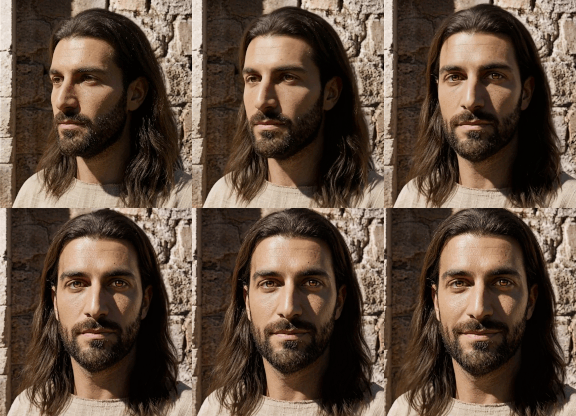
These is what the AI generated:
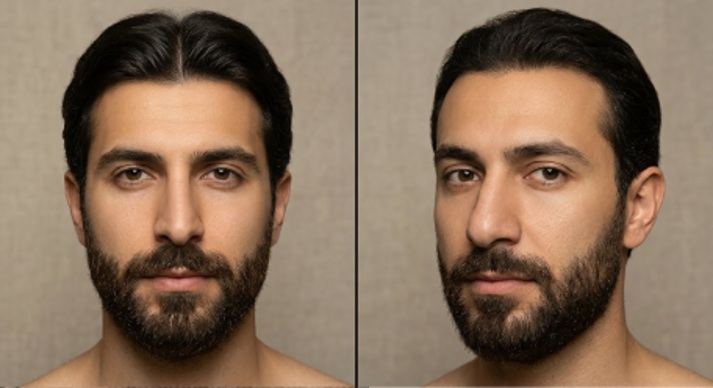
The result was amazing! I then gave the AI the following follow-up command:
"Use same rendering but with long hair"
The AI engine generated the following picture:
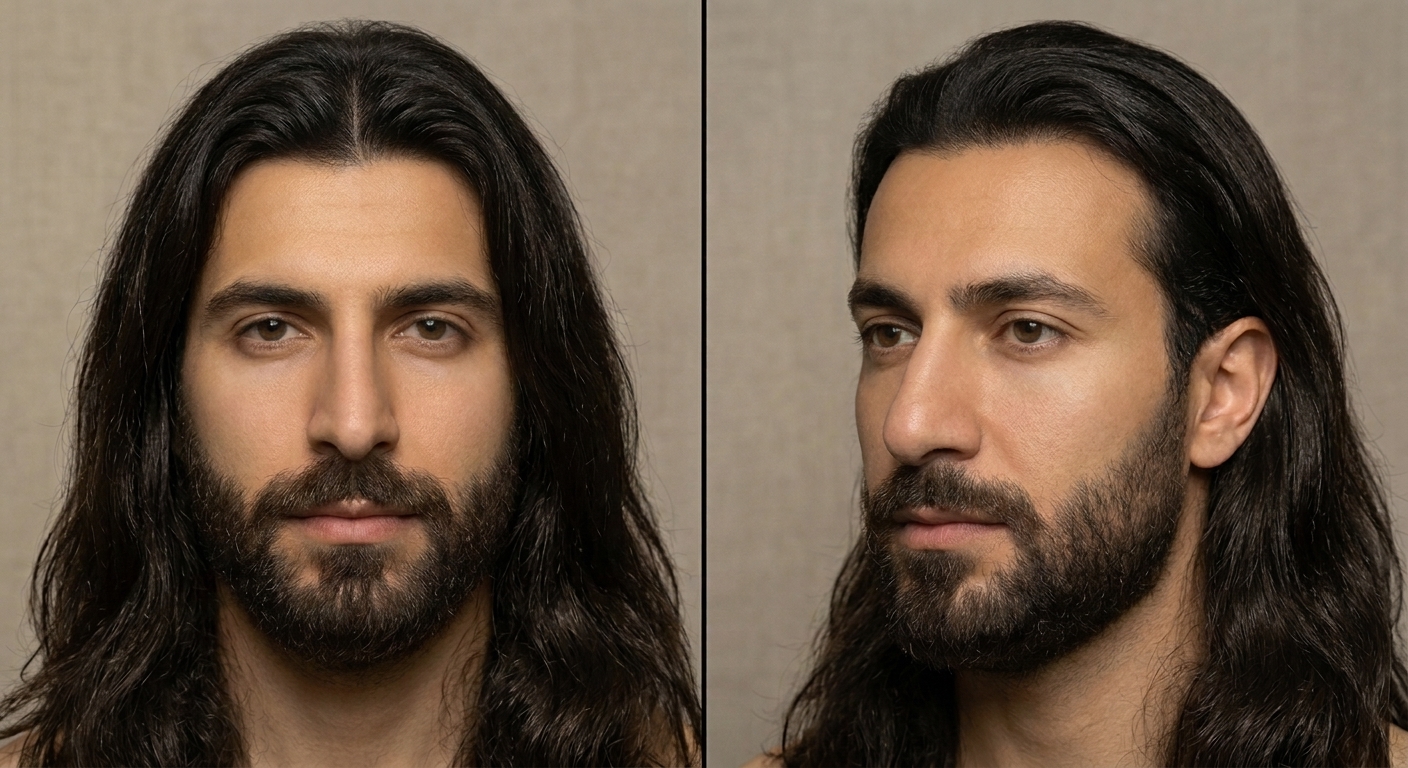
Now, that was truly remarkable—it looked exactly like Jesus is traditionally envisioned. Because the AI mapped out the two distinct viewpoints just as John had predicted (one looking forward and the other looking to the left), we can confidently infer that the cloth of Veronica’s Veil was indeed pressed against His face twice.
After a few final adjustments, this became the definitive rendition of the two faces of Jesus on the Veil:
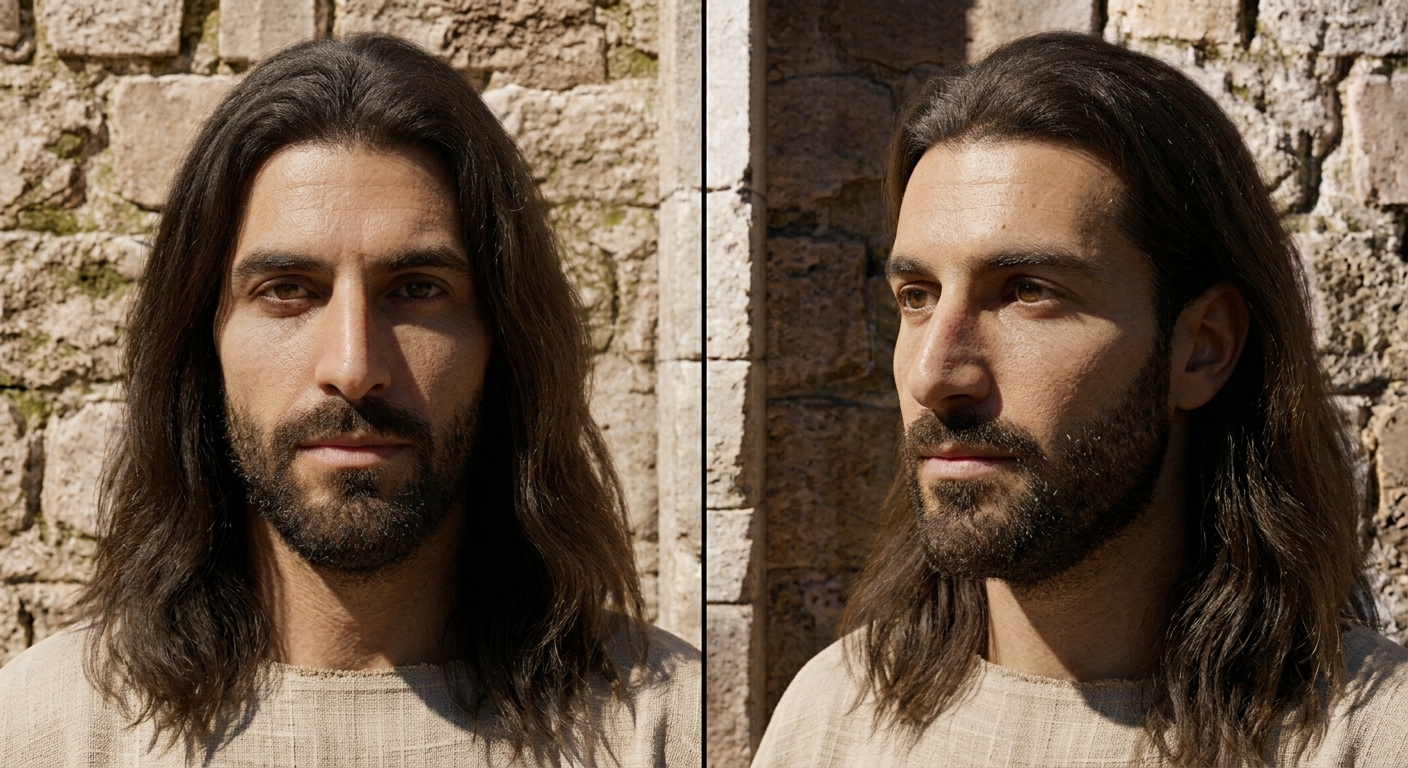
(Note: There are visible wounds belonging to Jesus on His nose and forehead on the actual Veil of Veronica. These historical details were not fully integrated into the AI renditions).
My friend John has made a major discovery on Veronica’s Veil. It is not just the physical verification of two overlapping, imprinted faces of Jesus, but an entire untold story of the Passion: a narrative of Veronica reaching Jesus from His side, wiping His face at an angle, and then Jesus turning fully toward her so she could wipe His face a second time.
Another thing that John pointed out is that the presence of two overlapping imprints of Jesus’s face—sharing the exact same facial proportions and matching wounds in identical locations—serves as profound evidence for the authenticity of Veronica’s Veil at the Vatican. Let's be realistic: no forger would think to add two superimposed faces with identical features looking from two completely different angles. There simply would have been no reason for a medieval or ancient copyist to do that.
Through this realization, John has providentially resolved the historical mystery of why some classical artists painted Jesus looking directly forward while others depicted Him facing to the left, despite all of them using the exact same Veil as their primary reference.
While studying a high-resolution photograph of the holy relic, John discovered what centuries of observers had entirely overlooked. First, he realized there are actually four distinct eyes visible on the cloth: one pair looking forward, and another pair looking to the left. He then recognized that these two pairs of eyes belong to two entirely separate, superimposed facial contours.
Because the two imprints are laid so closely on top of one another, they are easily misread as a single, distorted image. The ancient bloodstains and general darkening of the textile over time make it even more difficult for the human eye to isolate the individual profiles. Over the centuries, this visual confusion led various master artists to unknowingly blend structural elements from both distinct faces to produce a single, composite rendition of the Holy Face.